In the past week two seemingly unrelated macroeconomic events are signaling a massive risk for the future of global supply chains:
- Just two weeks after Taiwan's stock market value overtook the UK's, it surpassed Canada last week to become the 6th largest stock market with roughly $4.47 trillion in value.
- At the same time, the UK Government has committed to funding its own AI hardware infrastructure while seeking to work with "middle power nations," ( which Taiwan fits right into the category.)
However, Taiwan’s $4.47 trillion milestone is a global warning sign. Tech is dominating the world but the human context required to integrate it is not being emphasised enough. This over-concentration isn't just a manufacturing problem; it is a reflection of a global systemic risk.
The Capital Distortion
Here are two numbers that worth noticing:
-
The VC Skew: A staggering 61% of all global venture capital is currently funding AI startups.
-
The Hardware Trap: Of Taiwan’s $4.47 trillion market cap, over 60% (roughly $2.7 trillion) is concentrated purely in the AI sector—driven by TSMC, which alone accounts for nearly 45% of the total index value.
The Hardware vs. Service Gap
We are pouring trillions into the silicon, the servers and the data centres—building the fastest engines in human history—while neglecting the "sociological talent pool." This skew toward hardware at the expense of software and service preparation creates a fragile global foundation.
Many view Taiwan’s hyper-concentration as a localised issue. In our hyper-connected reality, however, a sustainable supply chain is built on the reliability derived from decades of cultural cultivation and training specialised talent.
Western Design, Eastern Execution
There is a fundamental philosophical divide in how we deploy this technology:
-
Western AI often focuses on "Generative"—the ability to "make things up."
-
Northeast Asian integration focuses on "Operational"—the discipline of "making things work."
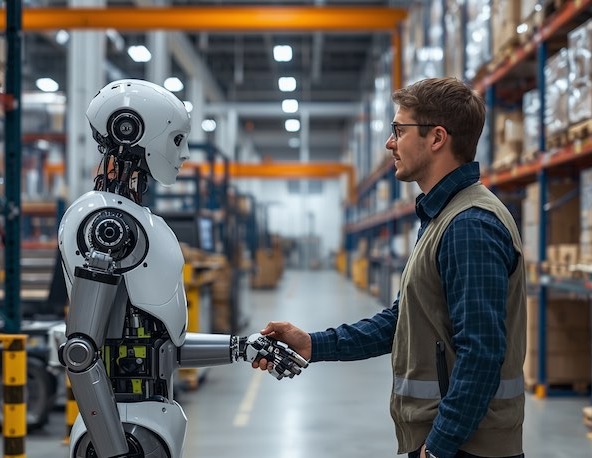
Taiwan sits at the essential intersection of Western design and Eastern execution. This is why the island is the lynchpin for international AI standards. The success of global integration won't just depend on chips; it will depend on cross-cultural translation, management nuance, and human oversight.
The Irreplaceable Professional
It is not to say that IEEE-level technical talents are less important. It is to say that while AI makes the world more efficient, we are facing an integration crisis. As chip manufacturing emission reportedly increased 4.5-fold in a single year, the irreplaceable professional is no longer the one who can operate AI. It is the one equipped with the sociological grounding to guide through black swan events where there is no historical data to learn from.
The true value of an experienced and trustworthy supply chain partner—like those found in Taiwan—lies in human decision-making. This becomes especially distinct when the playbook disappears.
Here are some recent examples:
The agility to pivot and filling the memory gap: While the giants switched all capacity toward High-Bandwidth Memory (HBM) for AI boom, they left the world starving for standard DRAM. This triggered a 2026 crisis where prices surged 800%. As competitors focusing on AI related contracts, Taiwanese partners like Nanya Technology demonstrated the its manufacturing adaptability. They leveraged decades of experience to maintain global stability, resulting in a 580% revenue jump by filling the gap for DDR4.
The Operational Moat: Taiwan’s dominance—controlling 90% of leading-edge nodes—is not just about machines. It is about a culture of survival. From achieving an unmatched 87.5% water recycling rate in a resource-scarce environment to companies like Quanta Computer and Foxconn figuring out the cooling methods and power grid integration issues that many world class firms used to ignore, these are the great examples of human communication and high-stakes troubleshooting in real-time.
When there is no reference in history to learn from, you don't need a faster processor or a larger data centre. On the contrary, you need a partner you can trust to navigate the unknown.
What else do you want to know about the "hidden champions" behind the Asian supply chain? Let us know!
We will try to uncover more of Taiwan’s Hidden Champions in the related fields!
What is your #1 bottleneck in expanding your supply chain right now?
For more Asian insights, follow BuonX Consultancy founder Betty on LinkedIn.
Ready to embark on your sustainable supply chain? Join BuonX Consultancy in turning vision into daily practice. Contact us today.