Throughout this four-part series, we’ve explored the "hard" tech of foundry wastewater recycling—from the Ultra-Pure Water (UPW) systems and the "magnets" of EDR to the silicon mining of backgrinding. While many see manufacturing as a world of cold machines, there is a profound utilization of nature’s wisdom hidden within the water management process.
In this final installment, we’re shifting our focus to Membrane Bioreactors (MBR). This is where the factory stops being just a machine and starts feeling like a living organism.
The "Staff" That Never Sleeps: Why and What Bacteria?
In the Science Parks of Taiwan and Arizona, we’ve seen how foundries drive the development of the "villages" surrounding them. Little does the public realize that every semiconductor fab is itself a small city. With thousands of employees working around the clock, these fabs generate massive amounts of organic wastewater—both from human presence and the organic chemicals used in manufacturing (such as photoresists and solvents).
While previous methods we discussed use physics to deal with raw materials, MBR handles the organic contaminants through... digestion.
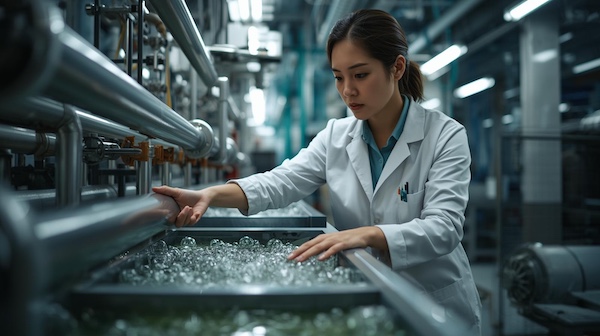
What is MBR? It combines biological treatment (using specialized bacteria) with high-tech membrane filtration. Essentially, "trained" bacteria act as the fab's digestive system, eating the organic pollutants. (Note: This wastewater usually comes from processes like photolithography and etching, rather than backgrinding). A membrane filter then "sieves" out the bacteria, leaving behind clean, reusable water.
The Farmers and Their Herd
The engineers in an MBR facility work with "staff" members quite different from their other colleagues. In this "probiotic factory," engineers essentially act as farmers. They are in charge of monitoring oxygen levels and pH to keep their bacterial workforce healthy. If the bacteria get "sick," the entire water recycling loop can come to a standstill.
Fun Fact: The Bacteria Are Trained to Be Picky Eaters
Some microbes are specifically cultivated to eat TMAH (Tetramethylammonium hydroxide)—a common chemical in chipmaking that is toxic to most other life forms. These "gourmet" bacteria turn a chemical hazard into a biological fuel.
The Socio-Economic Fact of MBR
Taiwan didn't advance MBR technology just for the sake of innovation; it was a portal of discovery born from necessity. MBR systems are roughly 50% smaller than traditional plants and operate as closed systems, eliminating the odors typically associated with industrial waste.
This addresses Taiwan’s most critical constraints: land and water scarcity. During the 2021 drought in Taiwan—just as global demand for chips was exploding—the government was forced to shut off irrigation to 180,000 acres of farmland to prioritize the semiconductor industry. This created significant societal conflict between "High-Tech" and "Livelihood."
However, over the past two years, the narrative has shifted. The Water Resources Agency (WRA) now highlights how the industry is "creating its own water" rather than "stealing" it. Because MBR requires less land and is odorless, NIMBYism (Not In My Backyard) campaigns against factory expansions have significantly decreased.
A Complete Ecosystem in the Supply Chain
Thanks to these unique challenges, Taiwan has nurtured many "hidden champions" in the MBR supply chain. From system integrators like CTCI, Ever-Clear, and Mega Union, to membrane providers like LCY Chemical, this ecosystem possesses irreplaceable expertise.
As countries like the US, Japan, and Germany build their own "Silicon Hubs," they would do well to look beyond the chips. By partnering with these experienced hidden champions, they can build ecosystems that are not just efficient, but truly sustainable.
What else do you want to know about the "hidden champions" behind the Asian supply chain? Let me know!
Inspired by readers' feedback, our next series will expand beyond water to explore the wider Circular Economy. We will try to uncover more of Taiwan’s Hidden Champions in the related fields!
What is your #1 bottleneck in expanding your supply chain right now?
For more Asian insights, follow BuonX Consultancy founder Betty on LinkedIn.
Ready to embark on your sustainable supply chain? Join BuonX Consultancy in turning vision into daily practice. Contact us today.