At the GTC 2026 keynote, Jensen Huang, founder of Nvidia and one of the leaders in the AI era, mentioned Taiwan Semiconductor Manufacturing Company (TSMC) eight times and Taiwan four times. To the casual audience, this was a nod to a critical supplier. To a strategist, it was an formal recognition of a "geopolitical anchor” that has more insights behind. Huang explicitly mentioned several times on how important it is to maintain partnership with Taiwan and further ensuring peace highlights a shift: Taiwan is no longer just a workshop; it also provides a new possibility for diplomacy for the future.
In an era defined by fracturing globalisation, Taiwan has built something more resilient than a "Silicon Shield” in what Chris Miller called it, a Chip War. It has a global recognition not just by technical innovation, but through a unique case study of transforming OEM (Original Equipment Manufacturer) model into a invaluable geopolitical chip.
It started with a survival strategy
To understand Taiwan’s unique role in global security, one must revisit its point of existential crisis. In 1971, upon losing its seat at the United Nations, Taiwan faced a vacuum of international recognition. The state needed to strike a position for its uncertain future-economically and geopolitically-while the number of its traditional diplomatic allies was plunging in a rapid pace. The response was not with a conventional diplomacy, instead, among all the efforts, there was one stood out. It did what it did the best: manufacturing.
By sending engineers to RCA(Radio Corporation of America) to master semiconductor manufacturing, Taiwan wasn't just building a future industry for a state that’s facing challenges; it was seeking a economic pillar as well as a reason to maintain its economic allies.
It was the birth of a unique national diplomacy strategy—not one based on the traditional exchanges between countries, but based on the industrial interdependence nature of the globalization. While traditionally, most nations seek power through political negotiations or sometimes, unfortunately, conflicts, Taiwan, through TSMC, sought its voice through OEM. To be more precise, it positioned itself as the strong support for the super powers in technology by pledging to be a pure-play foundry.
Turned a low cost OEM model into a Security Asset
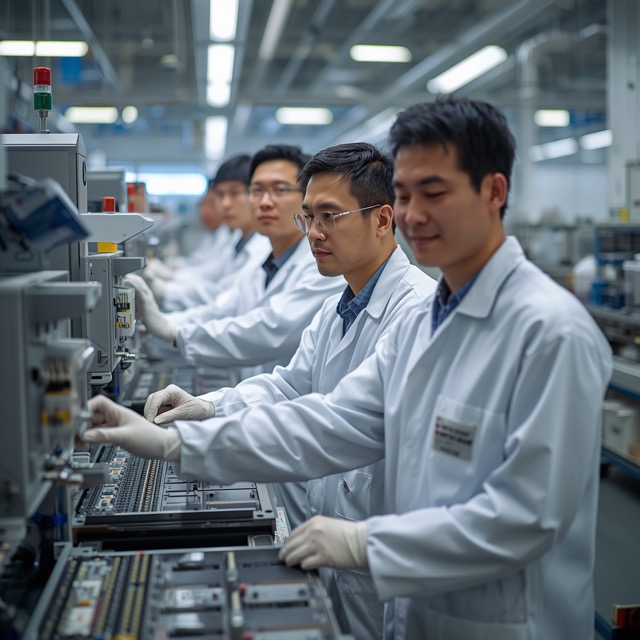
The decision by TSMC to never design its own chips—the "pure-play" model—is perhaps one of the most undervalued opportune strategies in modern history. In the 1980s, being an OEM was viewed as a low-margin, low tech-requirement practice, an endeavour for "developing countries”. Yet, despite with the capability and knowledge to do more, TSMC vowed to never compete with its customers from day one. TSMC then created a "Neutral Zone" in the heart of the global technology race later in the years.
Without this exact positioning, it would have taken TSMC significantly longer to secure the irreplaceable position in the popular and competitive “world’s factory” in the late 20th century.
Today, this model serves as a new approach to international stability. In a world practicing de-risking and reshoring, Taiwan provides an unparalleled factors for an infrastructure of strategic trust. From tech giants in Silicon Valley to green-energy innovators in Dresden, the "Taiwan Model" offers a friend shoring guarantee: a combination of quality, ethics and speed with an assurance that no proactive political threats against its partners will be initiated by the island.
A New Anchor for Global Security
This logic has paved the way for Taiwan and TSMC to become the model of friend shoring, extending its influence far beyond the boardroom and directly into the calculations and concerns with regional security. As Europe pursues "Strategic Autonomy” and navigates the complexities of the new world order. Along with the digital and green transitions, it would find in Taiwan a partner that does not seek to dictate, but to enable resilience.
What’s the next chip in hand?
TSMC has successfully helped to position Taiwan as a vital chip in the “Geopolitical Operating System (OS). ” In the system, any disruption targeting the island is risking the possibility of triggering a global system failure which no one would like to see. Looking back, Taiwan’s story offered the world a novelty diplomacy approach for stability. However, it took Taiwan 30 years and a degree of luck to transform its sunset advantages into a strategic edge. As the rapid dynamic shifting in geopolitics, the Silicon Shield faces new pressures, the question now is: What is the next “chip” for Taiwan?
What else do you want to know about the "hidden champions" behind the Asian supply chain? Let me know!
We will try to uncover more of Taiwan’s Hidden Champions in the related fields!
What is your #1 bottleneck in expanding your supply chain right now?
For more Asian insights, follow BuonX Consultancy founder Betty on LinkedIn.
Ready to embark on your sustainable supply chain? Join BuonX Consultancy in turning vision into daily practice. Contact us today.