In last article about how foundries can be possible in a desert of our Beyond the Chips series, we looked at how foundries can even exist in a desert. We dived into Taiwan's sophisticated water management, starting with Ultra-Pure Water (UPW)—the extreme purity required to make a chip. But the recycling journey doesn't stop there. Once that water is packed with minerals, salts, and silica, it becomes "concentrated wastewater." At that point, it’s impossible to recycle it back into UPW standards for chip making.
This is where Electro-Dialysis Reversal (EDR) comes in. What makes this technology so attractive is that it’s essentially a self-cleaning process that generates actual financial profit and makes the sustainability in business level.
The Problem with the "Standard" Solution
Water management hasn’t always been as strict as we’d hope. However, in the early 2000s, Taiwan’s science parks—which host the most critical semiconductor suppliers—began imposing 70-80% water recycling goals.
While the standard way to extract minerals is Reverse Osmosis (RO), the industry quickly realized that relying on RO alone creates a massive cost spike. The wastewater from the "fab" is often loaded with ions like silica, copper, and calcium. When this water hits the fine sieves of an RO system, it almost instantly clogs the filters, causing "scaling" and biofouling. Between 2000 and 2010, research highlighted a massive barrier: in these harsh environments, the lifespan of RO membranes could be as short as three days. Worse, it required heavy chemicals to clean the "slime" off the sieves.
Cleaning a clogged system means two things every consultant hates: expensive downtime and wasted water used just to flush the filters.
The EDR Advantage: Magnets over Sieves
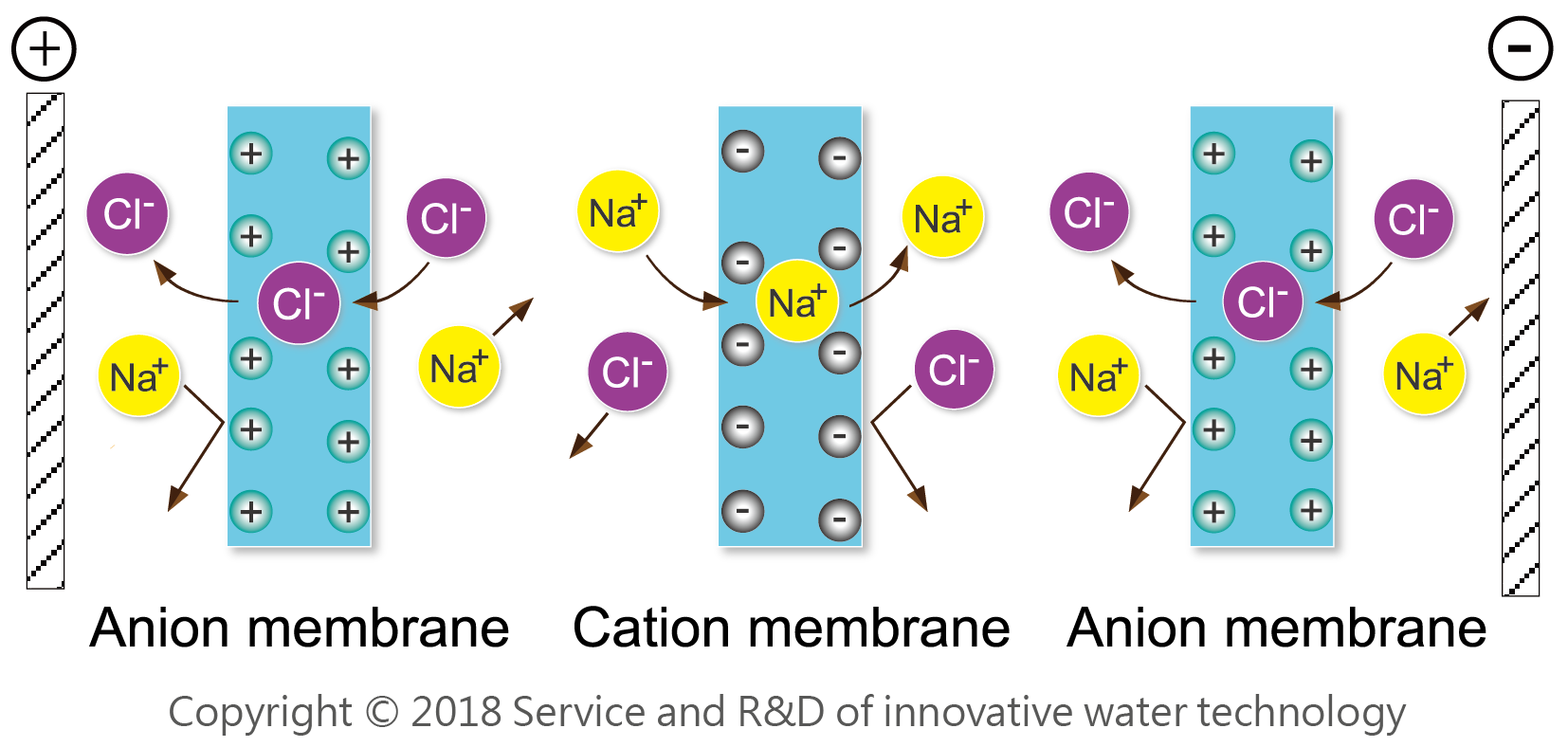
This is where EDR changes the game. It acts as a pre-step, protecting the RO filters by working with the nature of the waste rather than fighting it. Instead of a sieve, it acts more like a magnet.
-
Ionic Movement: It uses an electric field to pull sodium, salt, and mineral ions out of the water through specialized membranes.
-
The "Reversal": This is the secret sauce. The system periodically reverses its electrical polarity. This reversal automatically "pushes" away any mineral buildup on the membranes.
Because EDR is self-cleaning, it doesn't just make separating particles possible—it saves time and money. In the chip industry, where every second of uptime counts, that is vital. (Resource: For a technical breakdown of EDR vs. RO in high-silica environments, see the Industrial Technology Research Institute (ITRI) Water Technology Reports)
How Taiwan Became the Lead in the EDR Field
Taiwan’s dominance in EDR didn't happen by accident; it was born from a lack of space and the natural constraints I mentioned in Part 1.
A History of Adaptation In the 1990s, as Taiwan’s chip innovation gained momentum, the wastewater became increasingly "toxic" to both equipment and our limited land. The government, through ITRI—the R&D engine that drives the nation's industrial innovation—partnered with local engineering firms to adapt EDR for the semiconductor world.
The Industry Leaders Today, companies like Mega Union Technology (兆聯實業) and United Integrated Services (UIS, 漢唐) lead the world in EDR system integration. They have a massive competitive advantage because they grew up "in the fab." Their deep integration with TSMC and UMC (the foundries producing chips for giants like Apple and Nvidia) allowed them to learn exactly how to meet the intense requirements of advanced manufacturing. They are the true hidden champions of the supply chain.
The Insight for 2026
Building a sustainable operation means choosing the right partners who invest in "boring" infrastructure like EDR. It ensures that when the next drought hits, your production doesn't stop. For countries trying to establish their own self-sustaining ecosystems, this is the foundation.
In Arizona—one of the driest regions in the US—Taiwanese water expertise isn't just a "nice-to-have"; it’s the solution to making the desert bloom with silicon.
What else do you want to know about the "hidden champions" behind the Asian supply chain? Let me know!
In Part 3, we’ll look at how Taiwan turns sustainability into a business. We’ll tackle "Backgrinding Wastewater"—where we learn how to recover actual silicon from the water.
What is your #1 bottleneck in expanding your supply chain right now?
For more Asian insights, follow BuonX Consultancy founder Betty on LinkedIn.
Ready to embark on your sustainable supply chain? Join BuonX Consultancy in turning vision into daily practice. Contact us today.
Comments are closed!